The Escalade, in one paragraph
The Cadillac Escalade is the Toronto black car fleet's default luxury SUV: a full-size, three-row, all-wheel-drive vehicle in a standard (5.4 m) and an ESV (5.8 m) wheelbase, seating six (two second-row captain's chairs, a third row of two) or seven (a second-row bench), with cargo of about 720 litres behind the third row on the standard and 1,150 on the ESV (four to six large bags with the third row folded — the luggage capacity article), Cadillac's magnetic ride control and air suspension, a 6.2-litre V8 (a diesel on some, the Escalade IQ electric arriving in fleets — the hybrid and electric article), rear-seat screens, and the running boards and grab handles for the step-in. It is the Pearson run for a family or a two-week trip, the executive team of four, the wedding couple who want the room, the concert and the game for six, and the February morning for anyone; the sedan vs SUV article says when the sedan wins instead, the Navigator vs Escalade article compares the rival, and the fleet page shows the fleet's.
Every Toronto fleet runs Escalades and every dispatcher assigns them the same way: when the booking says four or more, or bags, or car seats, or snow, or "we want the big one" — and the Escalade's place in the trade is the result of twenty years of being the SUV a passenger recognises, a chauffeur trusts on the 401 in February, and a fleet can keep clean and quiet for five years and three hundred thousand kilometres. This guide covers the two wheelbases, the seating, the cargo, the ride, the powertrains, the winter, the amenities, the step-in, the Escalade against its rivals, the bookings, the fare, the fleet's age rule, and a worked Escalade day.
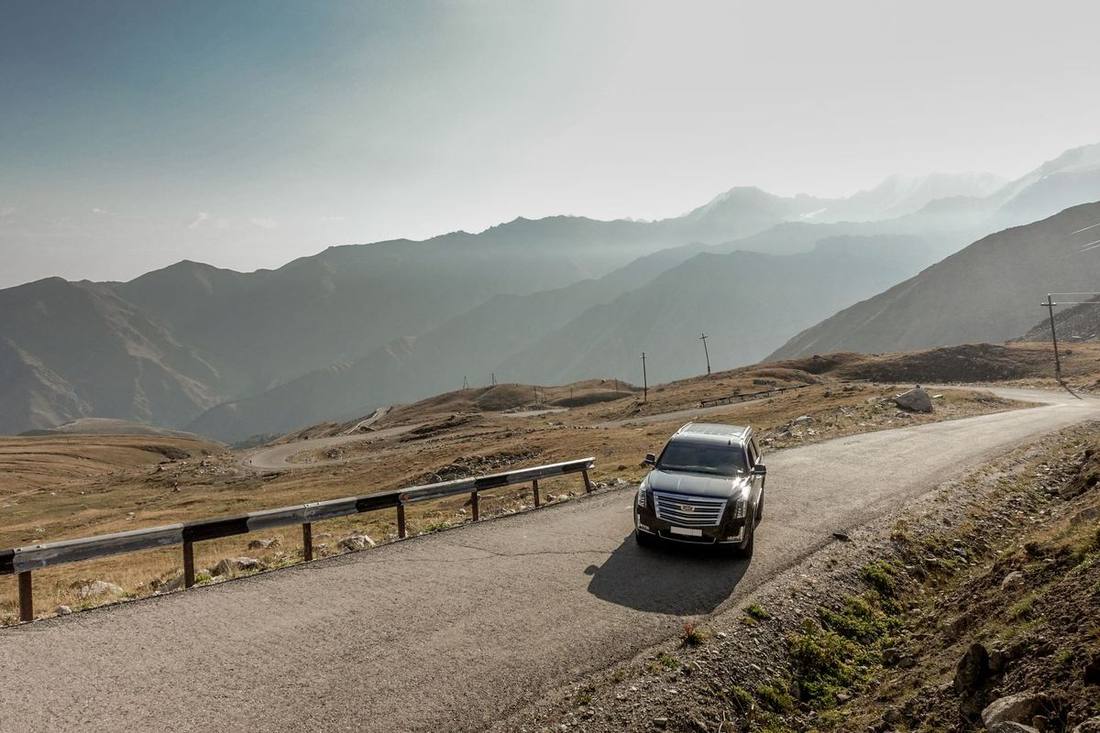
The two wheelbases
The standard Escalade (5.4 metres long, 3.07-metre wheelbase): six or seven seats, about 720 litres of cargo behind the third row (two large bags upright, or three flat), 2,050 behind the second row with the third folded (five to six large bags), and the turning circle that takes a downtown laneway; the everyday vehicle for four passengers and their bags. The Escalade ESV (5.8 metres, 3.41-metre wheelbase): the same seats with more third-row legroom, about 1,150 litres behind the third row (four large bags with six aboard), 2,650 behind the second row (eight large bags), and 40 centimetres more length to park; the airport vehicle for six with luggage and the families with luggage article's answer. A fleet runs both and dispatch assigns by the bag count — the sedan vs SUV article's rule.
The seating
The fleet's configuration is six: two second-row captain's chairs (heated, ventilated, reclining, with a console between and a pass-through to the third row) and a third row of two adults (or three children — the child seats article says two car seats in the second row and a booster in the third); the seven-seat version has a second-row bench that some fleets keep for the family bookings; the front passenger seat carries a seventh adult on request (the what makes a car a black car article says the trade prefers the rear). Four adults in the second row and the front passenger seat with the third row folded is the executive team's configuration, and the roadshow article's four bankers ride that way with the pitch books behind.
The cargo
The luggage capacity article's numbers: standard — two large behind the third row, five to six behind the second; ESV — four large behind the third row, eight behind the second; a golf bag lies flat behind the second row on either, a ski bag needs the third row folded and the length of the ESV, a stroller folds behind the third row on the ESV and needs the second-row floor on the standard, a wheelchair folds behind the second row on either (the accessible service article covers a chair that does not fold). The power tailgate, the cargo net and the chauffeur's loading order (the first-out bags last in) are the in-car amenities article's small things.
The ride
Cadillac's magnetic ride control (the dampers read the road a thousand times a second) and, on the newest generation, the air suspension with the adaptive dampers give the Escalade the best ride in its class — firmer than an S-Class, better than a Suburban, level with a Navigator — and the cabin's noise at 100 km/h on the 401 is a conversation's; the second row's captain's chairs recline and the red-eye article's passenger sleeps; the third row is a third row (the Sprinter guide says six adults for an hour want the Sprinter).
The powertrains
The 6.2-litre V8 (the fleet's standard — the torque for a full load on the Burlington Skyway, the fuel economy a fleet's cost), the 3.0-litre Duramax diesel (some fleets — the highway economy on the Niagara and Muskoka runs), and the Escalade IQ (the electric — 700 kilometres of range on Cadillac's figure, the hybrid and electric article's winter question, arriving in Toronto fleets as the charging allows); the environment article covers the fleet's idling rules and the fleet maintenance article the service interval.
The winter
All-wheel drive with a two-speed transfer case on the standard drivetrain, 20 centimetres of ground clearance, 2,700 kilograms of mass, the winter tires article's tires from November to April, heated everything — the Escalade is the fleet's storm-day vehicle, the one dispatch assigns to the 6 a.m. Pearson run when fifteen centimetres fell overnight (the Pearson winter storm article), the one that takes the Oakville crescent the plow has not reached, and the one the winter driving article's chauffeur drives with the defensive driving article's training; it is not immune (mass and height are a crosswind's and a black-ice patch's), and the buffers apply.
The amenities
Rear-seat screens (two 12.6-inch on the newest, HDMI and streaming), the rear climate zone, the heated and ventilated captain's chairs, the wireless charging and the USB-C at every seat, the Wi-Fi hotspot, the 36-speaker AKG audio on the top trims (a fleet runs the Premium Luxury and the Sport trims), the rear sunshades, the console's cooler on some, and the in-car amenities article's water, tissues, chargers and mints; the corporate car service page's clients ask for the screens for a presentation and the families with luggage article's children for the cartoons.
The step-in
The Escalade's floor is 55 centimetres from the road; the power-deploying running boards drop to 35 and the A- and B-pillar grab handles and the chauffeur's arm do the rest; the seniors' guide says a passenger with a bad hip prefers a sedan's step down and a passenger with a bad back prefers the Escalade's step up, and the sedan vs SUV article's dispatcher asks which.
The Escalade against the Navigator and the Suburban
The Navigator vs Escalade article has the full comparison: the Navigator's twin-turbo V6, its softer ride and its slightly larger third row against the Escalade's V8, its firmer ride and its screens; the Suburban (and the Yukon XL) is the same platform as the ESV with a plainer cabin and a lower fare in the fleets that run it (the what makes a car a black car article says a Suburban is a black car if it is black, clean, licensed and chauffeured); a passenger who books "an SUV" gets whichever the fleet has clean and closest, and a passenger who books "an Escalade" gets an Escalade.
The bookings
The Pearson run for a family or a couple with a trip's bags; the executive team of four with the roadshow's books; the wedding couple who want the dress's room (the bridal party transport article); the concert and the game for six; the ski day with the skis in the ESV; the golf day with four bags flat; the film crew's talent; the funeral's immediate family; the proposal with the photographer in the third row; and the February morning for anyone.
The fare
Above the sedan's on every route — the how much does a black car cost article works a Pearson run and an hourly day for both, the engine quotes the date, and the sedan vs SUV article says the difference disappears when a sedan's trunk forces a second car; the ESV and the standard are the same fare in most fleets and dispatch assigns by the bags; the what is included article says the screens, the water and the Wi-Fi are included.
The fleet's age rule
The fleet maintenance article's five-year rule is an Escalade's — a fleet Escalade runs 60,000 to 80,000 kilometres a year and is retired at five years or 350,000, whichever first, because the air suspension, the magnetic dampers and the interior are past a professional standard after that; the vehicle cleaning article covers the detail between every trip, and a passenger who steps into a fleet Escalade should find a vehicle that looks a year old.
A worked Escalade day
An Oakville family of five, a Saturday in February, Terminal 3 for two weeks in Cancún: five checked bags, three carry-ons, two car seats, twelve centimetres overnight. 5:30 a.m.: the ESV at the Oakville crescent (unplowed — the all-wheel drive and the clearance), the car seats installed the night before on the child seats article's protocol, the eight pieces behind the second row with the third row folded and the two older children in the second-row captain's chairs, the youngest in the front-passenger-mounted seat? — no: the third row up for the youngest's booster and four bags behind it, four in the aisle and on the front floor with the chauffeur's net. (The dispatcher had asked the bag count and sent the ESV; a standard would have sent two vehicles.) 6:15: the QEW and the 427 at the winter storm article's pace; 7:00: Terminal 3's departures curb, the cart, the bags. Two weeks later: the return with the same vehicle, the same seats, and the same dispatcher's question.
Escalade quick reference
| Element | Standard | ESV |
|---|---|---|
| Length / wheelbase | 5.4 m / 3.07 m | 5.8 m / 3.41 m |
| Seats | 6 (2 captain's + 2) or 7 (bench); 7th adult in front on request | The same, with more 3rd-row legroom |
| Cargo behind 3rd row | ~720 L — 2 large bags | ~1,150 L — 4 large bags |
| Cargo behind 2nd row | ~2,050 L — 5–6 large | ~2,650 L — 8 large |
| Ride | Magnetic ride control; air suspension on the newest; a conversation at 100 km/h | The same |
| Powertrain | 6.2 L V8; 3.0 L diesel on some; Escalade IQ electric arriving | The same |
| Winter | AWD, 2-speed transfer case, 20 cm clearance, 2,700 kg, winter tires Nov–Apr — the storm-day vehicle | The same |
| Amenities | Rear screens, rear climate, heated/ventilated chairs, USB-C, Wi-Fi, AKG audio, sunshades | The same |
| Step-in | 55 cm floor; running boards to 35 cm; grab handles; the chauffeur's arm | The same |
| Age rule | Retired at 5 years or 350,000 km | The same |
Booking an Escalade
The fleet page shows the fleet's Escalades; the engine quotes the date and asks the bags; the Pearson page, the corporate car service page and the hourly chauffeur page book it for the run, the day and the hour; dispatch assigns the ESV when the bags need it. Ask for it by name if the name matters.
The Escalade at the curb
The vehicle a passenger recognises is also the vehicle a doorman recognises: the Toronto luxury hotels guide's porte-cochères hold a lane for it, Pearson's Door A lanes take it with the tailgate open and the GTAA permit on the windshield, the Scotiabank Arena's and the Rogers Centre's drop lanes see a hundred of them on a game night, and the King Street corridor's side streets are where the chauffeur waits because an Escalade is 2.1 metres wide and does not fit a Yorkville laneway's curb with a delivery van beside it. The chauffeur's habits are the vehicle's — the running boards deployed before the door opens, the tailgate's height checked against the garage's bar, the third row folded before the bags and raised after, and the vehicle cleaning article's wipe of the running boards after a slush day so the next passenger's coat stays clean.






