The Sprinter, in one paragraph
The Mercedes-Benz Sprinter in a Toronto black car fleet is a high-roof executive van — 11 to 14 passengers in forward-facing leather captain's chairs (the executive layout) or perimeter seating with a bar (the limo layout) or 14 forward seats with a luggage cage (the shuttle layout) — with a standing-height cabin (a passenger walks upright to the seat), a sliding door and a step, rear cargo for 14 bags in the shuttle layout and 8 to 10 in the executive, Wi-Fi, USB at every seat, screens and a fridge, and a 3-hour minimum on the hourly that beats three SUVs on every group booking from eight up. It is the group airport transfer's vehicle, the corporate shuttle's, the wedding party's, the wine tour's and the roadshow team's; it is rear-wheel drive with a 4x4 variant for the winter, it does not fit a downtown garage under 2.7 metres, and Toronto's bylaw licenses it as a limousine up to its seat count. The limo bus vs Sprinter article covers the step up and the fleet page shows it.
Ten years ago a group of twelve in Toronto travelled in three SUVs, a stretch, or a school bus with the seats torn out; today they travel in a Sprinter, and the reason is the cabin: two metres of standing height, a walk-in door, a seat that faces forward and reclines, a window that opens, a USB port at the elbow, Wi-Fi, a cooler, and a driver's cab separated by a partition or open to the passengers as the booking wants. This guide covers the Sprinter's layouts, the cabin and the door, the luggage, the amenities, the bookings it was built for, the minimum and the arithmetic against three SUVs, the winter and the 4x4, the garages it cannot enter, the licensing, the chauffeur who drives it, the things it is not, and a worked Sprinter day.
The three layouts
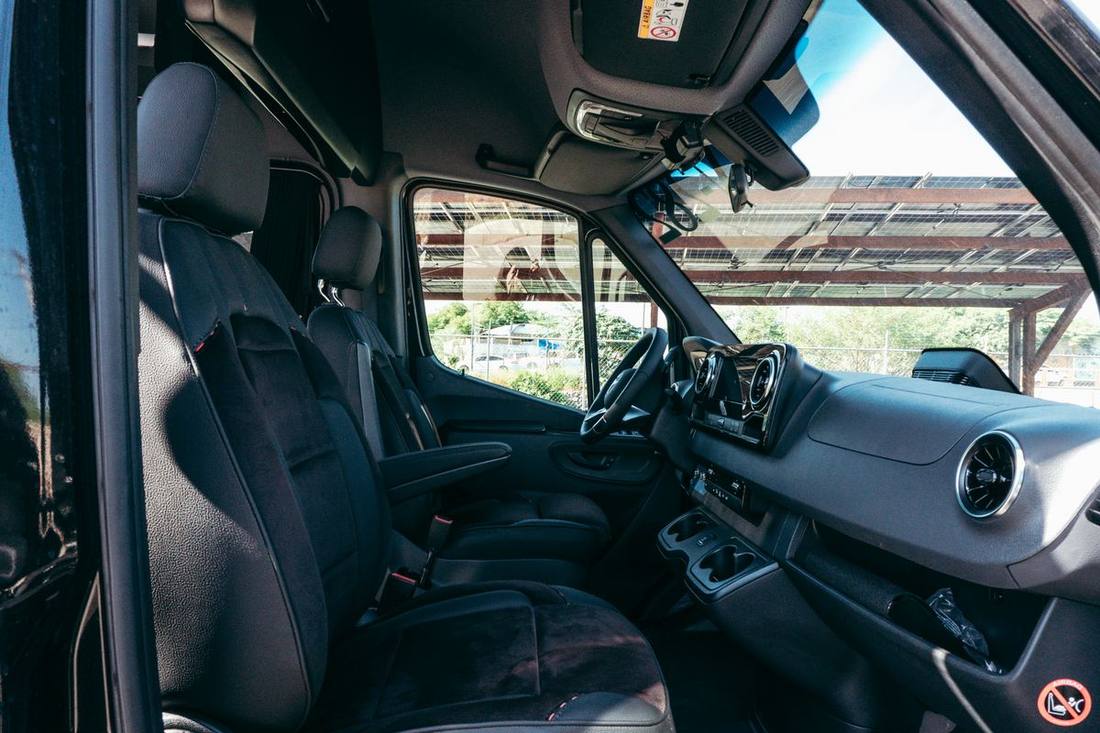
The executive Sprinter (11 to 12 passengers): forward-facing leather captain's chairs in rows of two with a centre aisle, each seat reclining with an armrest, a fold-out table on some, a USB port and a reading light, the standing-height aisle, a rear bench of three or a rear cargo area behind a bulkhead, a 32-inch screen forward, a fridge, a partition to the driver — the corporate team's vehicle, the roadshow's, the conference's VIPs'. The limo Sprinter (10 to 12): perimeter leather seating facing inward, a bar with glassware and a cooler (the stag and bachelorette article's licence rules apply), fibre-optic ceiling lighting, a sound system, screens — the party's vehicle, the wedding party's and the birthday's, with less luggage room. The shuttle Sprinter (14 to 15): forward-facing seats in rows of three (a single and a pair), a rear luggage cage for 14 bags, no bar — the group airport transfer's vehicle and the employee shuttle's. Dispatch assigns the layout to the booking, and the fleet page shows which the fleet runs.
The cabin, the door and the step
The Sprinter's high roof gives 1.9 to 2.0 metres of interior height — a passenger of average height walks upright from the door to the seat, and a tall one stoops slightly — which is the whole difference from a stretch (a crouch and a slide along a bench) and an SUV (a climb into a third row); the sliding side door is a metre wide with a powered or a manual step at 40 centimetres from the road, a grab handle on the pillar, and the chauffeur's hand; the seats are at chair height, not floor height, and a passenger in a suit or a gown sits as at a table. The accessible service article notes that a Sprinter with a rear lift is the fleet's wheelchair vehicle, and the seniors' guide says the step and the handle make it easier than an SUV for many older passengers.
The luggage
The shuttle layout's rear cage takes fourteen large bags stacked (the luggage capacity article's table); the executive layout's rear area behind the bulkhead takes eight to ten large bags or a team's roller cases; the limo layout takes four to six in the rear and the passengers' small bags at their feet; and operators running airport shuttles for sports teams and film crews tow an enclosed trailer for the equipment (the group transfers article's hockey bags and the film production article's cases). A group of fourteen with fourteen checked bags is one shuttle Sprinter; a group of twelve with twelve checked bags and twelve carry-ons is a Sprinter and a trailer or a Sprinter and an SUV.
The amenities
Wi-Fi (the vehicle's own hotspot — the in-car amenities article covers the data), a USB-A and USB-C port at every seat and a 110-volt outlet or two, a forward screen for a presentation or a game (HDMI from a laptop), a rear-view camera display, a fridge with the water and, on request, the corporate client's stocking, individual reading lights and vents, a privacy partition on the executive layout, a PA for the chauffeur's announcements on the shuttle layout, and the limo layout's bar, lighting and sound; a team that works between the airport and the office works in the Sprinter as at a table, and the roadshow article's bankers rehearse the pitch on the screen.
The bookings it was built for
The group airport transfer: the group transfers article — a team of ten from Terminal 1 with the bags, met at Door A with the sign, one vehicle, one manifest. The corporate shuttle: the employee shuttle article — the hotel-to-office loop for a visiting team, the conference's hotel-to-MTCC waves, the trade show's booth staff. The wedding party: the bridal party transport article — the dresses' room, the forward seats, the sliding door. The wine tour: the Niagara wine tour article and the Prince Edward County article — fourteen guests, four wineries, the cooler for the purchases. The roadshow team: the roadshow article — six bankers, the pitch books, the screen. The stag, the birthday, the prom, the quinceañera's court: the stag and bachelorette article, the birthday article, the prom article, the quinceañera article. The day trip: the Niagara Falls day trip article, the Muskoka article, the Blue Mountain article with the skis in the rear. The film crew: the film production article.
The minimum and the arithmetic
The Sprinter's hourly minimum is three hours (the hourly vs point-to-point article explains the minimums) and its airport transfer is a flat quote on the engine; the how much does a black car cost article works it: a Sprinter for twelve on a Pearson run costs less than two SUVs and far less than three, a Sprinter for four hours costs less than two SUVs for four hours, and a Sprinter's per-head cost for a wine tour of fourteen is the cheapest chauffeured seat in the fleet. Below eight passengers the SUV wins; at eight the Sprinter ties; from nine up the Sprinter wins on every booking, and the limo bus vs Sprinter article says the limo bus takes over at fifteen.
The winter and the 4x4
The Sprinter is rear-wheel drive with a long wheelbase and a high centre of gravity — competent on a plowed road on the winter tires article's tires and cautious on an unplowed crescent or the Blue Mountain article's hills — and Mercedes builds a 4x4 (all-wheel-drive) variant that the fleets running ski trips and cottage runs carry; on a storm day dispatch assigns the 4x4 Sprinter to the Muskoka run and the rear-wheel one to the downtown shuttle, and the winter driving article's buffers apply doubly to a vehicle that cannot take a snowbank at speed.
The garages it cannot enter
A high-roof Sprinter is 2.7 to 2.8 metres tall and 6 to 7 metres long; most downtown parking garages have a 2.0-metre clearance and the hotels' porte-cochères 2.4 to 3.0 — the Fairmont Royal York's Front Street and York Street doors take it, the Four Seasons's porte-cochère takes it, the Hazelton's forecourt does, the Ritz's Wellington driveway does, the Shangri-La's does not (the University Avenue curb instead), the MTCC's south building loading dock does and the north building's Front Street lay-by is the drop, Pearson's Door A lanes take it (the height bar on the terminal's garage does not — the Sprinter uses the surface lot and the commercial lane), and Billy Bishop's Eireann Quay does. The chauffeur knows every clearance in the city and dispatch confirms the door the day before.
The licensing
Toronto's Vehicle-for-Hire bylaw licenses a limousine by its seating; a Sprinter up to its licensed seat count is a limousine with a limousine owner's licence and a limousine driver's licence (the Toronto limousine licensing article), the chauffeur holds an Ontario Class G for a vehicle under the bus threshold and a Class F or B for the larger configurations, the GTAA permit covers the Pearson pickup, and the limo insurance article's commercial policy covers the fourteen seats; a Sprinter converted beyond the limousine threshold is a bus under the province's rules and the limo bus vs Sprinter article covers the difference.
The chauffeur who drives it
A Sprinter chauffeur is a chauffeur first (how chauffeurs are vetted) with a van's habits: the height and the length in the mirrors, the wide turn at King and Bay, the loading at the sliding door with the step down and the handle, the fourteen bags in the cage in the order they come out, the PA for the announcements, the count at every stop (the group transfers article's headcount), and the defensive driving article's training for a tall vehicle in a crosswind on the Burlington Skyway.
What the Sprinter is not
It is not a stretch (no photograph at the curb — the stretch limousine guide says when the stretch still wins), not a limo bus (the limo bus vs Sprinter article — fifteen to thirty want the bus), not a coach (fifty want the wedding guest shuttles article's coach), not an SUV (four people in a Sprinter is a waste), and not a vehicle for a low garage.
A worked Sprinter day
A Boston law firm's team of ten, a Wednesday in March: the 8:10 a.m. arrival at Terminal 1 (the executive Sprinter at Door A with the sign, ten roller cases behind the bulkhead), the Financial District hotels guide's Ritz for the bags (the Wellington driveway, 2.9 metres), the client's Bay Street tower for the 10 a.m. (the King Street curb, the King Street corridor rules), the Sprinter on the hourly through the day — the lunch at a King West room, the afternoon at a second office on University, the 6 p.m. dinner at Canoe's Wellington lay-by — and the 9:30 p.m. return to the Ritz. Twelve hours on the hourly, one vehicle, ten passengers who worked on the screen between every stop, and three SUVs' worth of coordination avoided.
Sprinter quick reference
| Element | Detail |
|---|---|
| Layouts | Executive (11–12, forward captain's chairs, screen, partition); limo (10–12, perimeter, bar); shuttle (14–15, forward rows, luggage cage) |
| Cabin | 1.9–2.0 m standing height; sliding door 1 m wide; a 40 cm step with a handle; chair-height seats |
| Luggage | Shuttle: 14 large; executive: 8–10; limo: 4–6; a trailer for teams and crews |
| Amenities | Wi-Fi; USB-A/C at every seat; 110 V; forward screen (HDMI); fridge; lights and vents; PA; the limo layout's bar and lighting |
| Minimum | 3 hours on the hourly; a flat airport quote |
| Arithmetic | Beats two SUVs from 8 passengers, three from 9; the cheapest chauffeured seat for a group of 14; the limo bus takes over at 15 |
| Winter | Rear-wheel drive; a 4x4 variant for ski and cottage runs; doubled buffers |
| Height / length | 2.7–2.8 m tall, 6–7 m long; no garage under 2.7 m; most porte-cochères yes, the Shangri-La's no; Pearson's Door A yes |
| Licensing | A limousine under Toronto's bylaw up to its seat count; Class G/F/B as configured; GTAA permit; commercial insurance for 14 seats |
Booking a Sprinter
The hourly chauffeur page books the day; the Pearson page the group transfer; the engine takes the headcount, the bags and the layout in the notes; dispatch confirms the door's clearance the day before. Book a Saturday's Sprinter three weeks ahead in wedding and wine season.






