Shuttle vs black car, in one paragraph
An employee shuttle is a bus or Sprinter on a fixed route and schedule — a GO station, a subway terminus or a downtown hub to a suburban campus in Markham, Mississauga, Vaughan or Oakville, morning and evening — priced per hour of vehicle time and cheapest per seat when it runs full; an on-demand black car is a sedan or SUV booked per trip — an executive's meeting, a late worker's safe ride home, a visitor's transfer, the days and hours the shuttle does not cover — priced per trip and cheapest when the demand is irregular. The utilisation trap is a shuttle that runs half-empty (its per-seat cost doubles) and the on-demand trap is thirty employees booking cars for the same 8 a.m. commute (a shuttle at a fifth of the cost). Most companies land on a hybrid — a shuttle for the commute pattern that fills it and black cars on a corporate account for the rest — and this article gives the arithmetic, the use cases and the account structure that holds both.
Toronto's employment is no longer only downtown: the technology, pharmaceutical, financial-services and manufacturing campuses of Markham, Mississauga, Vaughan, Oakville and Brampton employ hundreds of thousands of people the subway does not reach, and a company that wants to recruit from the city has to move its people to the campus. The options are the employee shuttle — a scheduled bus or van between a transit node and the campus — and the on-demand black car, and the choice is an arithmetic and a use-case question that companies get wrong in both directions: shuttles that run empty because the schedule does not match the day, and on-demand accounts that bleed because thirty people book sedans for the same commute. This article works the arithmetic honestly: what a shuttle costs and when it fills, what a black car costs and when it wins, the utilisation trap in each, the hybrid that most companies land on, the use cases that belong to each, the late-night safety ride, the visitor and the executive, and the account that holds both.

What a shuttle is and what it costs
A shuttle is a vehicle and a chauffeur on the company's schedule — a 14-passenger Sprinter or a 24–30-passenger limo bus (the limo bus vs Sprinter article covers the class) — running a fixed route: Unionville GO to a Markham campus at 7:30, 8:00 and 8:30, back at 4:30, 5:00 and 5:30; Kipling station to an Etobicoke campus; a downtown hub to a Mississauga campus via the Gardiner and the 427. It is priced per hour of vehicle time on the hourly terms, with a minimum that the what is included in a fare article explains, and its per-seat cost is the hourly rate divided by the seats filled — which is the whole question. A Sprinter that runs full both ways is the cheapest per-seat transport in the trade after the TTC; one that runs with four passengers is not.
What a black car is and what it costs
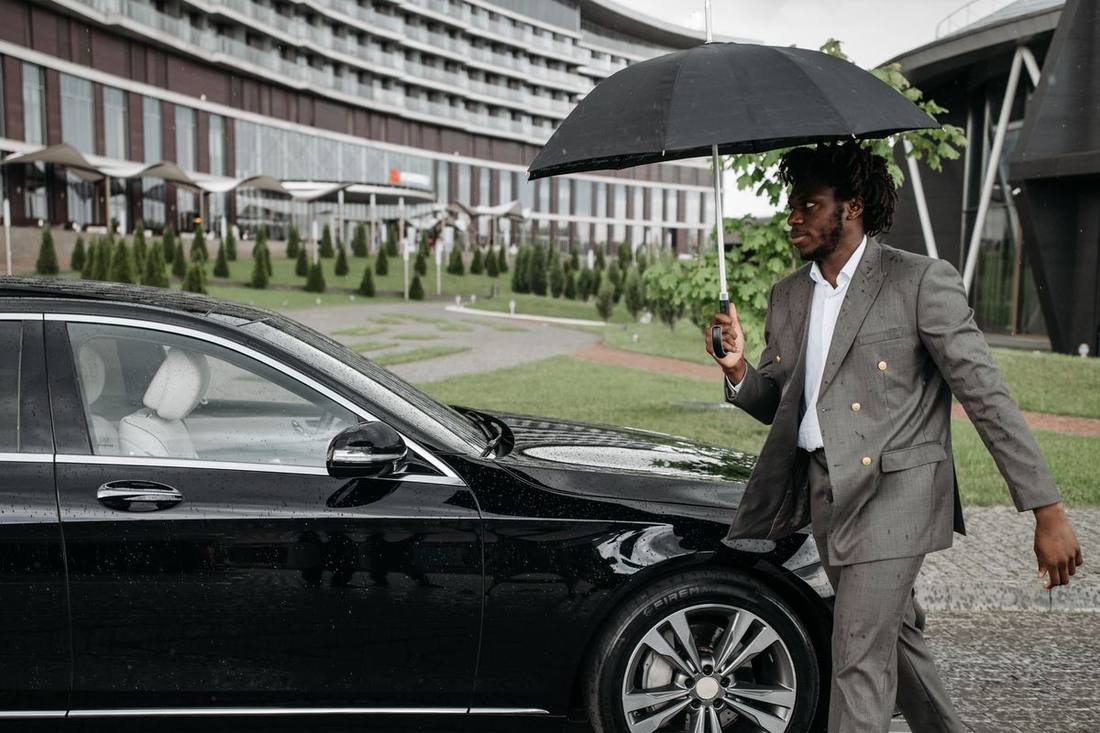
A black car is a sedan or SUV booked per trip at a fixed quote — the campus to Pearson, the campus to a downtown meeting, an employee's home at 11 p.m. — with no minimum beyond the trip, no vehicle sitting idle, and a cost that is the same whether one person or three ride. Its per-trip cost is higher than a shuttle seat and lower than an empty shuttle, and it wins wherever the demand is irregular: one executive, one visitor, one late night, one meeting across the city; the corporate account billing article shows how a month of such trips is billed and coded.
The utilisation trap, both ways
Run the numbers for a Markham campus of 300 with 40 employees who commute from the city. A Sprinter shuttle on three morning and three evening runs from Unionville GO is roughly six vehicle-hours a day; with 40 riders spread over the runs it carries seven per run and its per-seat cost is moderate; with 14 per run on two runs it is excellent; with four per run because the schedule does not match the day it is poor, and the company is paying for empty seats. Now the other trap: if those 40 employees each booked a black car from the GO station, the daily cost would be five to eight times the shuttle's, and the finance team would notice in a month. The arithmetic says: a shuttle for the commute pattern that fills it (survey the employees, set the runs to the real arrival times, adjust monthly), black cars for the trips that do not fit the pattern. The corporate travel policy article suggests the policy that says which is which.
The hybrid most companies land on
The hybrid is: a shuttle (or two) on the commute runs that fill, with a schedule reviewed monthly; a corporate account for on-demand black cars with a policy that says who may book (executives, visitors, anyone after 9 p.m., anyone with a medical or accessibility need, anyone whose meeting is across the city), and a booker who approves the rest; and the shuttle's chauffeurs and the account's dispatch under one roof so that a shuttle that breaks down or a run that is cancelled is covered by a car without a second vendor. A company that runs the hybrid pays for the pattern with the shuttle and for the exceptions with the cars, and the corporate car service page sets up both.
Use cases that belong to the shuttle
The morning and evening commute from a transit node; the lunchtime run to the plaza a campus lacks; the campus-to-campus run between a company's two suburban sites; the shift change at a plant with a fixed schedule; the summer intern cohort from a downtown residence; the conference or offsite where the whole company moves together (the conference transportation article). Each is a fixed pattern with a full vehicle, and each is the shuttle's economics.
Use cases that belong to the black car
The executive's airport run and the client meeting downtown (the executive car service article); the visitor's transfer from Pearson with meet and greet (the visiting clients itinerary article); the late-night safe ride home (below); the employee with a mobility need on a day the shuttle's step is a problem (the accessible limo service article); the recruit's interview day (the tech companies article); the day the shuttle is full, late or cancelled; the employee whose home is nowhere near the transit node. Each is irregular, one-off or personal, and each is the black car's economics.
The late-night safe ride
The use case that decides most companies is the late night: an employee who works past 9 or 10 — a quarter-end, a release, a deal — should not be walking to a bus, and a company's duty of care (the duty of care article) says so. A policy clause — "any employee working past 9 p.m. may book a car home on the account" — costs a company a handful of trips a month and buys the recruiting and retention value of a workforce that knows it will get home; the passenger safety article and the women travelling alone article cover the ride itself and the chauffeur who waits until the door is open.
The campus the subway does not reach
Markham's 404 corridor (the technology and insurance campuses), Mississauga's airport corridor (the pharmaceutical and logistics head offices), Vaughan's employment lands, Oakville's and Burlington's corporate parks, Brampton's telecoms — each is 30 to 60 minutes from downtown and none has a subway; the service areas pages for Markham, Mississauga, Vaughan, Oakville and Brampton cover the roads, and the 407 (the 407 article) is the shuttle's and the car's friend at the peaks.
The account that holds both
One corporate account: the shuttle as a standing order (recurring rides article) billed monthly on the hourly terms; the on-demand cars as trips with cost centres; the policy on who may book what; the statement that shows both, so that the finance team sees the shuttle's fill rate and the cars' exceptions on one page and adjusts the mix quarterly; and the corporate account billing article's export to the company's systems.
A worked year: a Mississauga pharmaceutical campus
A campus of 500, 60 commuting from the city. Year one: a 24-passenger limo bus from a downtown hub at 7:15 and 8:00, back at 4:45 and 5:30 — 8 vehicle-hours a day, 45 riders on a typical day, a good per-seat cost; a corporate account for executives, visitors and after-9 rides, 30 to 50 trips a month. Mid-year review: the 7:15 run carried 8, the 8:00 run 30; the schedule moved to 7:45 and 8:15 and the fill rose. Year two: a second Sprinter added from a Port Credit GO stop for the Oakville and Burlington employees, and the on-demand trips fell as the shuttle caught them. The statement shows both; the finance team reads it quarterly; the mix is right for now and will change again.
Shuttle vs black car quick reference
| Question | Shuttle | Black car |
|---|---|---|
| Pricing | Per vehicle-hour (hourly terms, minimum applies) | Per trip, fixed quote |
| Cheapest when | The vehicle runs full on a fixed pattern | Demand is irregular, one-off or personal |
| The trap | Runs half-empty; per-seat cost doubles | Thirty people book the same commute; 5–8× the shuttle |
| Best for | Commutes from a transit node, shift changes, campus-to-campus, offsites | Executives, visitors, late nights, accessibility, the days the shuttle doesn't fit |
| Vehicles | Sprinter (14) or limo bus (24–30) | Sedan, SUV |
| Review | Monthly fill rate; adjust the schedule | Monthly statement; adjust the policy |
| Account | Standing order on the hourly | Trips with cost centres |
Setting up the hybrid
The corporate car service page opens the account for both; an email with the campus, the transit nodes and a rough employee count starts the shuttle's schedule; the corporate travel policy article supplies the policy that keeps the cars for the exceptions.
The survey that sets the schedule
The single step that separates a shuttle that fills from one that does not is the employee survey before the schedule is set: where do you live, which GO or subway station would you use, what time do you arrive at the campus on a typical day, what time do you leave, how many days a week are you on site. Forty answers set two morning runs and two evening runs that match the real day rather than a manager's guess, and a second survey after three months adjusts them; a hybrid-work pattern — Tuesdays to Thursdays on site — means the shuttle may run three days and the cars cover Mondays and Fridays for the few who come in. Dispatch builds the survey for a company that asks and reads the results with the office manager.
The shuttle's chauffeur and the passengers' names
A shuttle that runs daily has a regular chauffeur who learns the passengers' names and their habits — who is always on the 7:45, who texts when they are running late, who needs the step for a knee — and a company that keeps the same chauffeur keeps the shuttle's ridership; the chauffeur vs driver article describes the difference a professional makes on a route that could be a bus, and the a day in the life article the shuttle chauffeur's morning.
When the shuttle is cancelled
A snow day, a holiday, a campus closure, a quarter-end when half the team stays late past the last run — the shuttle's standing order is paused or the run is dropped by a text to dispatch, and the employees who still need to travel book cars on the account under the policy's exception clause; nothing is charged for the paused run, and the cancellation policies article covers the notice the hourly terms ask for. The hybrid's virtue is exactly this: the pattern and the exceptions under one roof, so that a cancelled shuttle is a text rather than a crisis.
The arithmetic at scale
A company with 200 city commuters to a Markham campus is a different problem — two limo buses on staggered runs from two transit nodes, a Sprinter for the Oakville and Burlington cluster via the 407, and a car policy tightened to executives, visitors and after-9 rides because the shuttle now catches nearly everyone; the limo bus vs Sprinter article covers the vehicle choice at that scale, and the account's monthly statement shows a fill rate that justifies the fleet.






