Child seats across the fleet, in one paragraph
Ontario's law requires a rear-facing seat for an infant under 9 kilograms, a forward-facing seat with a tether to 18 kilograms, and a booster until 36 kilograms, 145 centimetres or age eight — and although the Highway Traffic Act exempts taxis and limousines, a professional Toronto black car fleet does not use the exemption: it stocks the seats (an infant carrier, a convertible, a combination seat, a high-back and a backless booster, all with Canada's National Safety Mark), installs them at the depot before the pickup on the LATCH/UAS anchors or the seat-belt path with the tether and the recline checked against a written checklist by a chauffeur trained to do it, cleans them after every use, and provides them free of charge with the child's age and weight in the booking's notes. A sedan takes two seats in the rear, an SUV two in the second row and a booster in the third, a Sprinter three across; a family's own seat is installed by the chauffeur or the parent; and the airport limo with child seats article covers the Pearson run and the unaccompanied minors article the school run. The fleet page shows the vehicles.
The law's exemption for taxis and limousines dates from an era when a cab could not be expected to carry a seat for every fare, and it survives; a professional fleet ignores it because the physics do not — an unrestrained child in a collision at 50 km/h is thrown with the force of a fall from a fourth floor — and because a corporate account's travel manager and a parent booking a Pearson run both ask the same question: "do you have a car seat?" The answer is yes, installed, free, and cleaned. This guide covers the law, the exemption and why the fleet does not use it, the seats the fleet stocks, the installation and the checklist, the chauffeur's training, which vehicles take which, the family's own seat, the cleaning, the free-of-charge rule, the booking, the airport run, the school run, the edge cases, and a worked installation.

Ontario's law
The Highway Traffic Act's child seat regulation: a rear-facing seat for a child under 9 kilograms (20 pounds), and recommended until the seat's rear-facing limit; a forward-facing seat with a tether for a child of 9 to 18 kilograms (20 to 40 pounds); a booster for a child of 18 to 36 kilograms (40 to 80 pounds) who is under 145 centimetres (4 feet 9 inches) and under eight years old — the booster ends when any one of the three is reached; a seat belt after that, and the back seat until thirteen. The fine for the driver is $240 to $1,000 and two demerit points, and the seat must carry Canada's National Safety Mark (the round maple-leaf sticker — a seat bought in the United States without it is not legal in Canada). Transport Canada's guide has the stages.
The exemption, and why the fleet does not use it
The regulation exempts "a taxicab, a limousine or a vehicle used for the transportation of passengers for hire" from the child seat requirement — the driver is not fined if a child rides unrestrained in a licensed limousine — and a professional fleet does not rely on it: the duty of care article's standard is the child's safety, not the driver's liability; the passenger safety article's physics are the same in a limousine as in a family car; the corporate accounts' RFPs ask; the limo insurance article's underwriters ask; and a parent who is told "we're exempt" books elsewhere. The fleet's rule: no child under the booster's limits rides without the correct seat, and a booking that arrives at the curb with an unannounced infant waits for the seat from the depot or the nearest vehicle that carries one.
The seats the fleet stocks
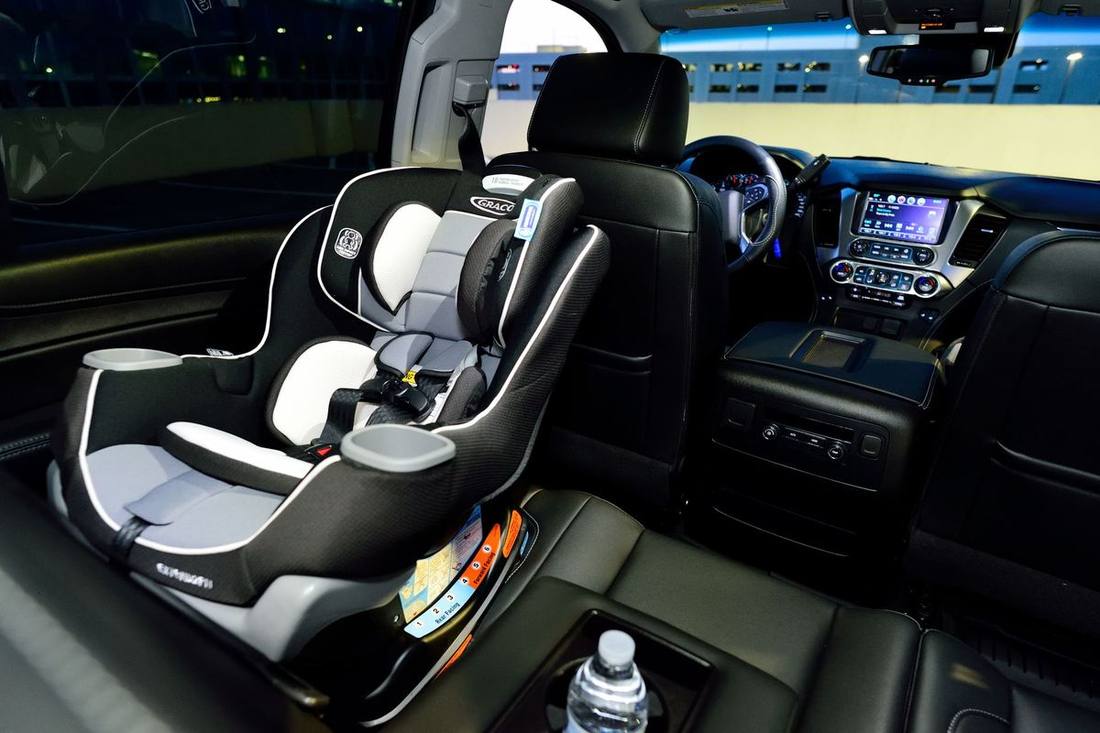
The infant carrier (rear-facing, birth to 10 to 16 kilograms depending on the model, with a base that stays in the vehicle and a carrier that clicks in — the fleet stocks the bases and the carriers; a family's own carrier clicks onto a compatible base or is belted in without one). The convertible (rear-facing from birth to 18 to 22 kilograms, then forward-facing to 25 to 30 — the fleet's workhorse for the one- to four-year-olds). The combination seat (forward-facing with a harness to 30 kilograms, then a high-back booster to 45 — for the four- to eight-year-olds). The high-back booster (with the belt guides and the head support — for the five- to eight-year-olds in a vehicle with a low seat back). The backless booster (the cushion with the belt guide — for the older booster child in a vehicle with a head restraint; the fleet's most-carried item because it fits every vehicle's trunk). The brands are the ones sold in Canada with the National Safety Mark (Graco, Britax, Clek, Diono, Evenflo, Chicco), replaced at the manufacturer's expiry date (six to ten years from manufacture — the date is on the seat) and after any collision; every vehicle carries a backless booster in the trunk, every SUV a high-back, and the depot holds the carriers, the convertibles and the combinations for the bookings that name them.
The installation
At the depot, before the pickup, ten to fifteen minutes: the seat matched to the child's stage from the booking's notes; the vehicle's LATCH/UAS anchors (in every rear seating position's outboard seats and, in the SUVs, the third row's outboard seats — the Escalade has them in both rows) or the seat-belt path (the belt through the seat's belt path, locked — the fleet's vehicles have locking retractors — and the seat pressed into the cushion with the chauffeur's knee); the tether clipped to the vehicle's tether anchor and tightened (forward-facing seats; the tether is not optional in Canada); the recline angle checked against the seat's indicator (a rear-facing infant's seat at 30 to 45 degrees); the movement test (less than 2.5 centimetres at the belt path when pulled side to side and front to back); the harness height set for the child (at or below the shoulders rear-facing, at or above forward-facing) and the chest clip's position (armpit level) explained to the parent; and the checklist signed on the chauffeur's app with a photograph to dispatch. The child seats airport article shows a parent finding it done.
The chauffeur's training
Every chauffeur who installs seats has taken a certified installation course (the Child Passenger Safety Association of Canada's technician training, or the manufacturer-specific training the fleet arranges — the how chauffeurs are vetted article's continuing training), refreshed every two years, with the fleet's own checklist and the a day in the life article's depot routine; a chauffeur who has not taken the course does not install a seat and the booking goes to one who has. The defensive driving article's training covers the driving with a child aboard (the smoother stops, the wider margins).
Which vehicles take which
A sedan (S-Class, E-Class): two seats in the rear's outboard positions (LATCH on both), the middle seat unusable with two seats installed, a third passenger in the front; a rear-facing infant seat fits behind the front passenger seat moved forward; a booster in any position. A standard SUV (Escalade, Navigator): two seats in the second row's captain's chairs (LATCH on both), a booster or a third seat in the third row's outboard position (LATCH on one side on most; the belt path on the other), two adults with them. A long-wheelbase SUV (ESV, Navigator L): the same with more third-row room — three seats and three adults. A Sprinter (Sprinter guide): the forward-facing rows take a seat in every position with the belt path (LATCH on the outboard seats of the executive layout) — three across in a row, a family of eight with four children in one vehicle. A stretch (stretch limousine guide): the side-facing bench cannot take a child seat (a child seat must face forward or rear) — a child in a stretch rides in a booster on the forward-facing rear seat only, and the birthday article's children's party stretch is booked with that understood. A limo bus: the same as the stretch; the prom article's passengers are past the booster age. The accessible vehicle: a seat in the forward-facing positions.
The family's own seat
A family who brings their own seat (the one the child knows, the one they will use at the destination) has it installed by the chauffeur on the same checklist — the chauffeur reads the seat's label for the LATCH weight limit and the belt path, checks the National Safety Mark and the expiry date, and declines a seat that is expired, recalled, damaged or American without the mark (and offers the fleet's) — or by the parent, with the chauffeur's check; on the Pearson departure run the family's seat travels checked or gate-checked and the fleet's seat is used to the airport and back to the depot, and on the arrival run the fleet's seat is waiting because the family's is in the hold. The families with luggage article covers the seat and the stroller in the trunk.
The cleaning
After every use — the vehicle cleaning article's standard applied to a seat a toddler has occupied: the cover removed and washed on the manufacturer's setting, the harness wiped (never submerged — the webbing weakens), the buckle rinsed, the shell wiped, the crumbs vacuumed from the crevices, the seat dried and reassembled, and the checklist's cleaning line signed; a seat that a child was sick in is out of service for a full wash and dry. A parent who lifts a child into a fleet seat finds it as clean as the vehicle.
The free-of-charge rule
The seat, the installation and the cleaning are included in the fare (the what is included article) — the fleet does not charge for a child's safety and the cheap limo service article describes the operator who does or who says "we don't carry them"; the corporate account's profile stores the children's stages so the assistant does not re-enter them, and the in-car amenities article lists the seat among the requests dispatch fills.
The booking
On the engine or by phone: the number of children, each one's age and weight (or the stage — "rear-facing," "forward-facing," "booster"), whether the family brings its own, and the vehicle class the luggage capacity article's bag count demands; dispatch confirms the seats on the confirmation, the chauffeur installs them at the depot, and the pickup is on time because the ten minutes were at the depot, not the curb. A booking that names no children and arrives with one waits for the seat — the fleet's rule, kindly.
The airport run with an infant
The child seats airport article's run: the infant carrier's base installed at the depot, the family's carrier clicked in at the door (or the fleet's carrier waiting), the stroller in the trunk, the Pearson Door A load in five minutes, the international arrivals article's customs wait with the fleet's seat ready at the curb, and the red-eye article's 5 a.m. pickup with the seat installed the night before.
The school run
The unaccompanied minors article's daily run — a booster for the seven-year-old, the same chauffeur every morning, the seat left installed for the term on the corporate account's standing booking, the parent's text at the school's door — and the women travelling alone article's vetting standard for the chauffeur who drives a child alone.
The edge cases
A child of nine who is short: the law says eight or 145 centimetres or 36 kilograms, whichever first — a nine-year-old is legal without a booster, and the fleet offers one anyway if the belt does not sit on the shoulder. Twins in a sedan: two seats in the rear, a parent in the front. Three children under eight in a sedan: not possible — an SUV or a Sprinter. A premature infant: the carrier's minimum weight (some are 1.8 kilograms) and the hospital's car-seat test — the hospital row article's discharge run books the carrier. A child with a disability: a special-needs seat the family brings, installed by the chauffeur with the family's instructions, or the accessible service article's vehicle. A grandparent's booking for a visiting grandchild: the stage in the notes and the seat waiting. A last-minute booking with a child: dispatch sends the nearest vehicle with the right seat in the trunk (every vehicle carries a backless booster; the SUVs a high-back) or the depot's seat by the next vehicle.
A worked installation
A Leaside family's Terminal 1 run, Saturday 6 a.m.: a four-month-old (rear-facing), a three-year-old (forward-facing) and a six-year-old (booster), six large bags and a stroller — the luggage capacity article says an ESV. Friday 9 p.m. at the depot: the chauffeur (course-certified 2025) installs the infant base in the second row's right captain's chair on the LATCH (the recline indicator at 40 degrees), the convertible forward-facing in the left captain's chair on the LATCH with the tether to the seat-back anchor (movement under 2.5 centimetres), and the high-back booster in the third row's right position on the belt path; the photograph to dispatch; the checklist signed. Saturday 5:50: the door; the family's own infant carrier clicks onto the base; the six-year-old into the booster with the belt across the shoulder guide; the three-year-old's harness at the shoulders, the chest clip at the armpits, shown to the mother; the bags behind the third row and in the aisle; 6:00 the Bayview on-ramp. 6:40: Terminal 1 Door A departures; the carrier off the base for the flight; the base and the two seats back to the depot for the cleaning. The family's return in two weeks is on the same booking, the same seats, the same chauffeur.
Child seats quick reference
| Stage | Ontario's rule | Fleet's seat | Where it fits |
|---|---|---|---|
| Rear-facing | Under 9 kg (recommended to the seat's limit) | Infant carrier + base, or convertible rear-facing; NSM; 30–45° recline | Sedan rear outboard (front seat forward); SUV 2nd row; Sprinter any forward row |
| Forward-facing | 9–18 kg, with a tether | Convertible or combination, harness; tether mandatory | Sedan rear outboard; SUV 2nd row (LATCH) or 3rd row; Sprinter any row |
| Booster | 18–36 kg, under 145 cm, under 8 | High-back (low seat backs) or backless (with a head restraint); every vehicle carries a backless | Any forward-facing position with a lap-shoulder belt |
| Seat belt | After the booster; back seat until 13 | — | — |
| The exemption | Taxis and limousines are exempt from the fine | The fleet does not use it | — |
| Installation | — | At the depot, 10–15 min, by a course-certified chauffeur; LATCH/UAS or belt path; tether; recline; < 2.5 cm movement; checklist + photo | — |
| Own seat | — | Installed by the chauffeur (label, NSM, expiry checked) or the parent with a check; expired / recalled / no-NSM seats declined | — |
| Cleaning | — | After every use: cover washed, harness wiped, buckle rinsed, shell wiped, vacuumed | — |
| Cost | — | Free — seat, installation, cleaning | — |
| Booking | — | Children's ages and weights (or stages) in the notes; own seat yes/no; the bag count | — |
Booking with children
The engine's notes take the ages and the stages; the Pearson page books the airport run; the corporate car service page's account stores the children's profiles; dispatch confirms the seats and the chauffeur installs them at the depot. Name the children and the seats are waiting.






