Hospital row, in one paragraph
University Avenue's hospital row — Sick Kids (555 University, the atrium entrance on Elizabeth Street), Toronto General (200 Elizabeth, the Elizabeth Street and University Avenue entrances, and the Munk Cardiac Centre's), the Princess Margaret Cancer Centre (610 University, the main entrance on Murray Street at University), Mount Sinai (600 University, the Murray Street and University doors), and Women's College (76 Grenville, the Grenville Street entrance) — is served by a black car that knows each entrance's drop-off loop, the ambulance lanes on University and Elizabeth a car must never block, and the patterns of a hospital passenger: the appointment run (dropped at the loop fifteen minutes before, collected on a text), the family's daily visit on a standing order, the discharge with equipment (a wheelchair, an oxygen concentrator, a walker — the accessible vehicle where needed), the out-of-town patient's week at a hotel or a patient residence, the visiting physician's day on an institutional account, and the discretion a diagnosis deserves. The hospitals' own patient-transport programmes cover the medical transfers; a black car covers the rest.
The five hospitals on University Avenue treat more patients than any other square kilometre in Canada, and their patients, families and physicians arrive by car all day: the parent bringing a child to Sick Kids for a 9 a.m. clinic, the spouse visiting Toronto General's cardiac floor every afternoon for three weeks, the out-of-town patient on the Princess Margaret's treatment schedule, the surgeon visiting from Boston for a week of cases, the discharge on a Friday with a walker and a bag of prescriptions. A black car serves each of them differently from an airport run — the timing is the clinic's, the door is a specific loop, the passenger may be frightened or unwell, the equipment needs a vehicle that takes it — and a chauffeur who works hospital row knows the doors, the loops, the lanes and the manners. This guide covers each hospital's entrance, the ambulance lanes, the appointment run, the daily visit, the discharge, the out-of-town patient, the physicians, the accessible vehicle, the hospitals' own transport programmes, discretion, and a worked week.
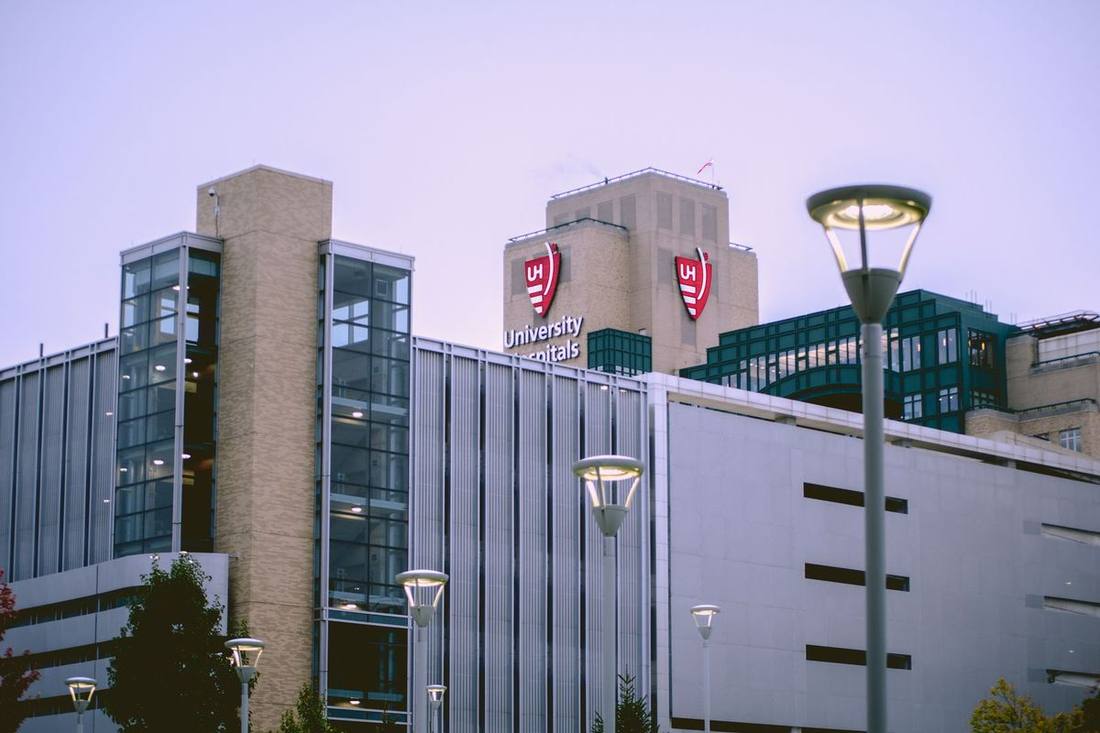
Each hospital's entrance
Sick Kids (the Hospital for Sick Children, 555 University): the main entrance and drop-off loop are on Elizabeth Street at the atrium (the hospital's east side, reached from Gerrard or Dundas via Elizabeth), with the emergency entrance on Gerrard; the University Avenue facade has no public drop-off. Toronto General (200 Elizabeth): the Elizabeth Street entrance with its drop-off loop (the hospital's east side, opposite Sick Kids), the University Avenue entrance (the west side, a lay-by on University's east curb north of Gerrard), and the Munk Cardiac Centre's entrance on Gerrard. The Princess Margaret (610 University): the main entrance on Murray Street at University (the north-west corner, a loop off Murray), with the University Avenue lay-by as the alternative. Mount Sinai (600 University): the Murray Street entrance (shared corner with the Princess Margaret) and the University Avenue doors with the lay-by on University's west curb south of College. Women's College (76 Grenville): the Grenville Street entrance (a block east of University, between Bay and Elizabeth) with its loop. The midtown guide covers Sunnybrook and the North York guide North York General for the patients who use them.
The ambulance lanes
University Avenue's east and west curb lanes between Queen and College carry ambulances to the emergency departments at Toronto General, Mount Sinai and Sick Kids, and the curb lanes at each emergency entrance — Toronto General's on Elizabeth, Sick Kids' on Gerrard, Mount Sinai's on University — are ambulance-only, marked and enforced; a car that stops in one is moved by security within a minute and ticketed by the City. The drop-off loops and the lay-bys are where a car stops, and a chauffeur who works the row uses nothing else. The passenger safety article covers a passenger who becomes unwell in the car and the chauffeur's route to the nearest emergency entrance.
The appointment run
A clinic appointment at 9 — the Princess Margaret's chemotherapy suite, Toronto General's transplant clinic, Sick Kids' cardiology, Mount Sinai's high-risk obstetrics — is a drop at the loop fifteen minutes before (the check-in queues), the chauffeur's wait on an hourly if the appointment is an hour, or a return transfer on a text if it is three, and the what is included in a fare article's wait allowance for the fifteen-minute overrun every clinic has. A patient who cannot say when the appointment will end books the hourly and the chauffeur waits on Elizabeth or Murray; the hourly vs point-to-point article works the arithmetic for a three-hour infusion.
The family's daily visit
A spouse, a parent or a child visiting a patient every day for two or three weeks — Toronto General's cardiac floor, the Princess Margaret's inpatient units, Sick Kids' wards — books a standing order: the same time, the same door, the same chauffeur, a text to move it when the visit runs long, and a fare that is the same each day; from Scarborough or Oakville the run is 45 minutes each way and the standing order is the family's one fixed thing in a week that has none. The families with luggage article covers the family arriving from another city with the bags and the Toronto luxury hotels guide the hotel a block from the row that the family stays in.
The discharge with equipment
A discharge — from surgery at Toronto General, from a course at the Princess Margaret, from Sick Kids with a child in a car seat and a monitor — is the run that needs the right vehicle: an SUV for a folding wheelchair, a walker and the bags; the accessible vehicle for a patient who stays in the wheelchair; a child seat for a child; and a chauffeur who loads the equipment, waits at the loop while the discharge paperwork runs late (it always does), and drives the passenger to the door at home rather than the curb. The luggage capacity article decides the vehicle before the discharge day and the hospital's discharge planner tells dispatch what is coming.
The out-of-town patient's week
A patient from Thunder Bay, Halifax or abroad on the Princess Margaret's or Toronto General's treatment schedule stays at a hotel on the row (the Chelsea, the DoubleTree on Chestnut, the Hilton on Richmond — the Financial District hotels guide covers the doors), at a patient residence (the Princess Margaret Lodge, the Ronald McDonald House for Sick Kids' families) or in Yorkville, and books the week as a standing order between the hotel and the loop, with the Pearson page's arrival and departure at either end; a patient's profile carries the hospital, the entrance, the equipment and the chauffeur's name so that the week's bookings are one message.
The physicians and the institutional account
The row's hospitals host visiting surgeons, researchers, grand-rounds speakers and recruits — the hospital and healthcare executive article's passengers — on the hospitals' and the foundations' corporate accounts, with the Pearson arrival, the hotel, the hospital's staff entrance (each has one: Toronto General's on Elizabeth, the Princess Margaret's on Murray) and the corporate account billing article's statement by department; a physician's own daily commute from Forest Hill to the row is a standing order on a personal profile.
The accessible vehicle
A patient who uses a wheelchair and stays in it for the ride, a patient on oxygen, a patient who needs a ramp rather than a step — the accessible service article covers the vehicle, the booking's lead time and the chauffeur's training, and hospital row is where most of the fleet's accessible bookings go; the hospitals' patient-transport programmes (below) cover the stretcher and the medical escort, and the accessible black car covers the patient who is well enough to sit and wants a private car rather than a medical van.
The hospitals' own transport programmes
Each hospital runs or contracts patient transport for the transfers that need medical staff — the stretcher between hospitals, the dialysis patient's thrice-weekly run, the escort for a patient who cannot travel alone — and Ontario's non-emergency medical transport services cover those; a black car is not one of them and does not carry a patient who needs medical care in transit. A black car carries the patient who is well enough to sit, the family, the physician, the discharge with equipment and the out-of-town week, and a chauffeur who is asked for more says so and helps the family find the right service. The duty of care article covers the incident procedure for a passenger who becomes unwell in the car.
Discretion
A hospital passenger's destination is a diagnosis, and the privacy and discretion article's standard applies with particular force: the chauffeur says nothing about who was driven where, the booking's notes carry the entrance and not the reason, the statement on an account shows the address and not the clinic, and a public figure's treatment at the Princess Margaret is known to the chauffeur and to no one else. A family that asks for the same chauffeur through a treatment course gets them.
A worked week
A patient from Sudbury on a three-week course at the Princess Margaret, staying at the Chelsea with a spouse. Sunday: met at Terminal 1 with meet and greet, an SUV for the bags and the walker, the Chelsea's Gerrard Street door. Monday to Friday, 8:30 a.m.: the standing order — the Chelsea to the Murray Street loop, the same chauffeur; 1 p.m. or on a text: the return. Wednesday: the spouse to a Yorkville lunch with a friend while the infusion runs. Saturday: the Toronto Islands for an afternoon the oncologist encouraged. Three weeks, fifteen clinic runs, one chauffeur, one profile, and a patient who never once thought about the ride.
Hospital row quick reference
| Hospital | Drop-off | Never stop |
|---|---|---|
| Sick Kids | Elizabeth Street atrium loop (from Gerrard or Dundas) | Gerrard emergency lane; University facade |
| Toronto General | Elizabeth Street loop; University Avenue lay-by (east curb north of Gerrard); Munk on Gerrard | Elizabeth emergency lane |
| Princess Margaret | Murray Street loop at University; University lay-by | University's curb lanes at the emergency doors |
| Mount Sinai | Murray Street entrance; University doors (west curb south of College) | University emergency lane |
| Women's College | Grenville Street loop | — |
| Appointment | Drop 15 min before; hourly or return on a text | — |
| Daily visit | Standing order; same chauffeur | — |
| Discharge | SUV or accessible vehicle; chauffeur loads equipment; waits for paperwork | — |
| Medical care in transit | Not a black car — the hospital's patient-transport programme | — |
Booking a hospital run
The engine takes the hospital's name with the entrance in the notes; the accessible service article books the accessible vehicle with its lead time; the standing orders article sets up a treatment course's week.
The other downtown hospitals
Beyond University Avenue, St. Michael's (Queen at Victoria — the Bond Street and Queen entrances, and the Financial District hotels guide's streets), Toronto Western (Bathurst at Dundas — the Bathurst entrance and the Entertainment District guide's Fashion District approach), the Hospital for Sick Children's research tower on Bay, CAMH on Queen West and the Bridgepoint rehabilitation hospital on the Don — each with a loop and an ambulance lane a chauffeur knows; Sunnybrook (the midtown guide), North York General and Humber River (the North York guide) and the Scarborough Health Network (the Scarborough guide) serve the outer districts and the same patterns apply.
The 4 a.m. surgery and the pre-dawn run
A surgery's 6 a.m. check-in — Toronto General's and Mount Sinai's day-surgery units, Sick Kids' pre-op — is the red-eye article's roster with a hospital's door: a 5 a.m. pickup from Oakville or Markham, the empty 401 or QEW, the Elizabeth Street loop at 5:50, and the family member who came along dropped at the Chelsea for a room; a chauffeur who works the row knows that the 6 a.m. check-in's family waits eight hours and books the return as an open transfer on a text.
Booking notes for hospital row
"Princess Margaret, Murray Street entrance, 8:45 a.m. appointment, walker; hourly, expect two hours" — the hospital, the door, the time, the equipment and the wait; the how to book online article shows the fields and a patient's profile keeps the door and the chauffeur for a course's weeks.






