Four ways off the airport
From Pearson to downtown Toronto: the UP Express runs from Terminal 1 to Union Station in 25 minutes every 15 minutes for about $12.35, and is the best option for a single traveller bound for the Financial District at rush hour with light luggage. The taxi and limo stand offers regulated flat fares by zone to the GTA — roughly $65 to $75 to downtown — with no booking and a queue that ranges from empty to forty minutes. Rideshare is cheaper than the taxi at quiet hours and surges past it at busy ones, with a walk to a separate pickup zone. A booked black car has a fixed fare quoted in advance, a chauffeur tracking the flight, a car at Door A on your text, child seats, meet and greet and the same price at 4 a.m. — and it is the option for families, groups, luggage, executives, late arrivals and anyone whose destination is not Union Station.
The comparison is worth doing honestly because the answer is not always the black car. The UP Express is a genuinely good airport train — on time, clean, twenty-five minutes — and for one person with a carry-on going to a Bay Street office at 8 a.m., it beats every car on the road. The taxi stand is regulated, insured and adequate. The rideshare apps are fine at 2 p.m. on a Wednesday. The black car's case is the cases the others handle badly: two or more passengers, luggage, children, a destination that is not downtown, an arrival after the train stops or at the surge hour, a corporate account that needs a receipt, and the peace of mind of a plate on a text. This article compares the four on cost, time, luggage, reliability and hour, with worked examples, and gives the honest verdict for each kind of traveller.
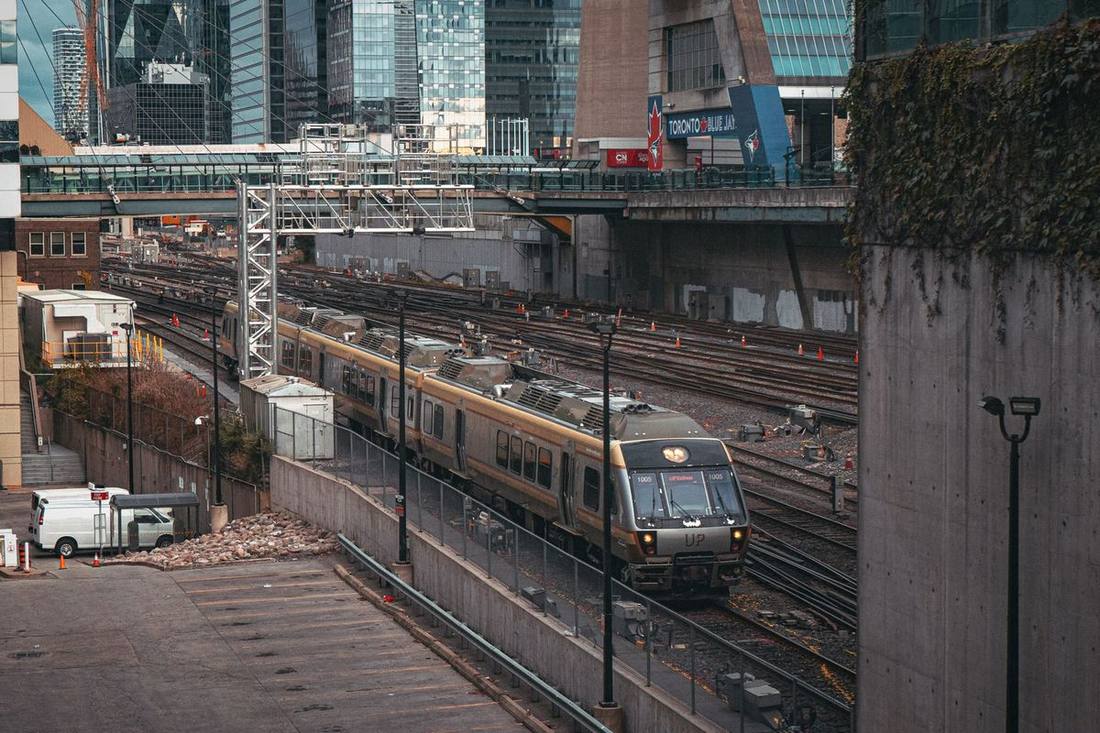
The UP Express: what it is and where it goes
The Union Pearson Express runs from a station on Terminal 1's departures level to Union Station downtown, with stops at Weston and Bloor (for the Line 2 subway and the west end), every 15 minutes from about 5:30 a.m. to 1 a.m., 25 minutes end to end. The fare is about $12.35 one way with a Presto card (less for seniors and youth, free for children under 12), and the trains have luggage racks, Wi-Fi and power. From Terminal 3 the passenger takes the Terminal Link to Terminal 1 first (ten to fifteen minutes with bags). At Union the passenger is in the Financial District's underground PATH, a ten-minute walk from most Bay Street towers and the Royal York, and a taxi or streetcar from anywhere else. It is the best airport rail link in Canada and the comparison should say so.
The taxi and limo stand: regulated flat fares
Pearson's taxi and limo stand — the marshalled queue at each terminal's arrivals level — dispatches GTAA-permitted taxis and airport limousines at regulated flat fares set by zone: roughly $65 to $75 to downtown, $50 to $60 to North York, $35 to $45 to Mississauga, and so on to the GTA's edge, plus HST, with the limousine rate about 15 per cent above the taxi rate. The vehicles are permitted, insured and inspected (the GTAA permits article explains the system), the fare is posted, and the queue's wait is the variable: nothing at 6 a.m., forty minutes at the afternoon bank. No booking, no flight tracking, no child seats, no choice of vehicle, a receipt on request.
Rideshare: cheap at noon, surging at six
Uber, Lyft and the rest pick up at a designated rideshare zone at each terminal (a walk from the arrivals doors), at app-set fares that undercut the taxi at quiet hours and exceed it — sometimes by double — at the peaks and late at night, when the surge multiplier reflects the drivers who are not there. The vehicles are private cars under Toronto's vehicle-for-hire bylaw, with no child seats and limited luggage; the wait is the driver's distance from the zone; the black car vs Uber Black article compares the premium tier, which is closer to a black car in vehicle and further in reliability.
The booked black car: what the fare buys
A booked black car's fare is fixed by distance and vehicle class and quoted before the trip — from Pearson to downtown it is above the taxi's flat rate and roughly at Uber Black's non-surge price — and it buys: a chauffeur assigned the evening before, flight tracking that moves the pickup with the flight, 60 minutes of included wait after an international arrival, a car at Door A on your text, child seats installed, a choice of sedan, SUV or Sprinter for the luggage, meet and greet as an add-on, the same fare at 4 a.m. and on Boxing Day, a receipt with HST for the expense report, and a corporate account that holds the traveller's preferences. The what is included article lists it all.
Cost: the honest numbers
For one passenger to the Financial District: UP Express about $12; taxi about $70 plus tip; rideshare $45 to $110 depending on the hour; black car sedan above the taxi. For two passengers: UP Express $25; the cars unchanged — and the black car is now the taxi's price per person plus the difference. For a family of four with luggage: UP Express $37 plus a stroller on a train and a taxi from Union; the taxi stand may send two cars; the black car is one SUV with seats. The how much does a black car cost article has the structure, and the engine the number for any address; the honest summary is that the train wins on cost for one or two people to Union, and the cars converge for everyone else.
Time: door to door, by hour
Terminal 1 to Bay and King at 8 a.m.: UP Express 25 minutes plus the wait for the train and the walk from Union — 40 to 45 door to door; the cars, 45 to 75 in the morning peak. The train wins. The same trip at 2 p.m.: train 40 to 45; cars 35 to 45. Even. At 11 p.m.: train 40 to 45 (if the destination is near Union); cars 30 to 35. The cars win, and after 1 a.m. the train is not running. Terminal 3 to Yorkville at any hour: train 55 to 65 with the Terminal Link, the ride and a taxi from Union; cars 35 to 60. The cars win. The rush hour article has the peaks, and the rule is that the train's advantage is real only at rush hour and only to Union.
Luggage, children and the number of passengers
One carry-on and a backpack: the train is easy. Two checked bags: the train's racks take them and the walk at Union is a chore. A stroller and two children: the train is a struggle and the taxi has no seats. A family of five with six bags: only a Sprinter or two taxis. A golf bag, a cello, a bicycle box: the cars. The luggage capacity article has the classes; the train's practical limit is what one person can carry through Union.
Reliability and the hour
The UP Express is reliable — its on-time performance is above 95 per cent — but it stops at 1 a.m., and it does not track your flight. The taxi stand is always there and its queue is unpredictable. Rideshare availability collapses at the hours it is needed most. The booked black car's reliability is the chauffeur's assignment and the flight tracking, and it is the only option that knew you were landing late. The red-eye article covers the overnight edge where the comparison is starkest.
The corporate traveller and the receipt
A business traveller expensing the trip needs a receipt with HST and, often, a policy-compliant vendor; the taxi's receipt is a scrawl, the rideshare's is an email, and the black car's is itemised on an account statement the finance department can reconcile. The corporate travel policy article and the duty of care article explain why many companies specify a booked car for airport transfers regardless of the fare difference, and the consulting firms article the weekly pattern.
Verdicts by traveller
One person, carry-on, Bay Street, 8 a.m.: UP Express. One person, two bags, Yorkville, 3 p.m.: taxi or black car; the black car if it was booked, the taxi if not. Two people, luggage, anywhere: black car or taxi; black car for the tracking and the fixed fare. Family with children: black car, for the seats alone. Group of six or more: Sprinter. Executive on an account: black car. Arrival after 1 a.m.: black car (the train has stopped; rideshare is surging). Destination in the 905: black car or taxi; the train does not go there. A visitor who wants to be met: black car with meet and greet.
The comparison in one table
| UP Express | Taxi stand | Rideshare | Booked black car | |
|---|---|---|---|---|
| Fare, T1 to downtown (1 pax) | ~$12 | ~$70 + tip | $45–110 by hour | Fixed, quoted in advance |
| Fare, 4 pax with luggage | ~$37 + taxi from Union | 1–2 cars | 1–2 cars, surge | 1 SUV, fixed |
| Time to Bay & King, 8 a.m. | 40–45 min | 45–75 | 45–75 | 45–75 |
| Time to Bay & King, 11 p.m. | 40–45 | 30–35 | 30–35 | 30–35 |
| Runs after 1 a.m. | No | Yes | Surging | Yes, same fare |
| Flight tracking | No | No | No | Yes |
| Child seats | N/A | No | No | Yes, installed |
| Serves the 905 | No | Yes (zone fares) | Yes | Yes (fixed fares) |
| Receipt for expenses | Presto record | On request | Itemised, HST, account | |
| Booking needed | No | No | App | Yes |
What to book
If the train fits, take it — we say so. If it does not, the engine has the fixed fare for any address and the Pearson page has the procedure.
The Bloor and Weston stops: the west end's shortcut
The UP Express's two intermediate stops widen its case: Bloor station connects to the Line 2 subway at Dundas West and puts the Bloor West and High Park neighbourhoods and the Junction fifteen minutes from the airport, and Weston station serves the Weston and Mount Dennis neighbourhoods on the airport's edge. For a single traveller to those neighbourhoods the train beats every car at any hour; for a family the taxi from Bloor station is the same problem as the taxi from Union.
Accessibility across the four
The UP Express is fully accessible with level boarding and space for wheelchairs; the taxi stand has accessible taxis on request with a wait; rideshare has an accessible option in some areas with long waits; and a booked black car has accessible vehicles booked in advance and a chauffeur who assists — the notice matters, and the article explains what we can and cannot do. For a passenger who uses a wheelchair the honest comparison is the train (if Union is the destination) or the booked accessible car.
The tipping question
Taxi drivers in Toronto expect a tip of ten to fifteen per cent; rideshare apps prompt for one; the UP Express has nobody to tip; and a black car's chauffeur — the gratuity guide explains — receives a gratuity that is either included on the account's terms or added at the passenger's discretion, and is never solicited at the curb. The comparison of fares should include it: the taxi's $70 is $80 with the tip, and the black car's fixed fare is the fixed fare.
A worked example: two consultants, one flight, two choices
Two consultants land at Terminal 1 from Chicago at 7:40 a.m. on a Tuesday; both are bound for the same client on Bay Street. One takes the UP Express — 7:55 train, Union at 8:20, the PATH to the tower by 8:32, $12 on Presto. The other has a booked sedan on the firm's account — Door A at 7:58, the Gardiner's morning crawl, the tower's lay-by at 8:50, the receipt on the account statement. The train won by eighteen minutes and $60. At 6 p.m. the same two fly home: the train-taker walks to Union in the rain with a roller bag and waits for the 6:15; the car-taker is collected at the lay-by at 5:45 and dropped at the departures curb at 6:35. The car won by twenty minutes and a dry suit. The consulting firms article covers the pattern; the honest answer is that most firms book the car both ways and let the consultant take the train when it fits.






