The 407 and the fare, in one paragraph
Highway 407 ETR is a privately operated toll road running 108 kilometres across the top of the GTA from Burlington to Pickering, with the provincially owned 407 East continuing to Clarington and the toll-free 412 (Whitby) and 418 (Oshawa) links to the 401. It charges per kilometre, by zone and time of day — peak rates on weekdays are the highest, off-peak and weekend rates lower, overnight lowest — collected by transponder (or by camera at a higher rate). Our vehicles carry transponders; the booking engine offers the 407 as a line item with an estimated toll on any booking where it could help, you approve or decline it, and it is charged at cost only if the chauffeur actually uses the road, itemised on the receipt. The chauffeur's rule: the 407 at the peaks and when the 401 or QEW is broken; the free roads when they are flowing.
The 407 opened in 1997 as a provincial highway and was leased to a private consortium in 1999 for 99 years, with the right to set tolls that have risen faster than inflation ever since; it is one of the most expensive toll roads in the world per kilometre and one of the most useful, because its congestion is rare and the 401 beneath it is the busiest highway in North America. For a black car service the road is a tool with a price: on a Pearson-to-Markham run at 5 p.m. it saves forty minutes and costs a meaningful sum; at 1 p.m. it saves five and costs the same. Our policy is to make the toll visible, optional and at cost, and to let the chauffeur's judgment on the day decide whether it is used. This article explains how the toll is calculated, what it costs on the runs people take, how the time saved compares by hour and destination, how the line item works at booking and on the receipt, the toll-free links, the camera charge, the corporate account's policy, and the rule the chauffeur applies.
How the 407 charges
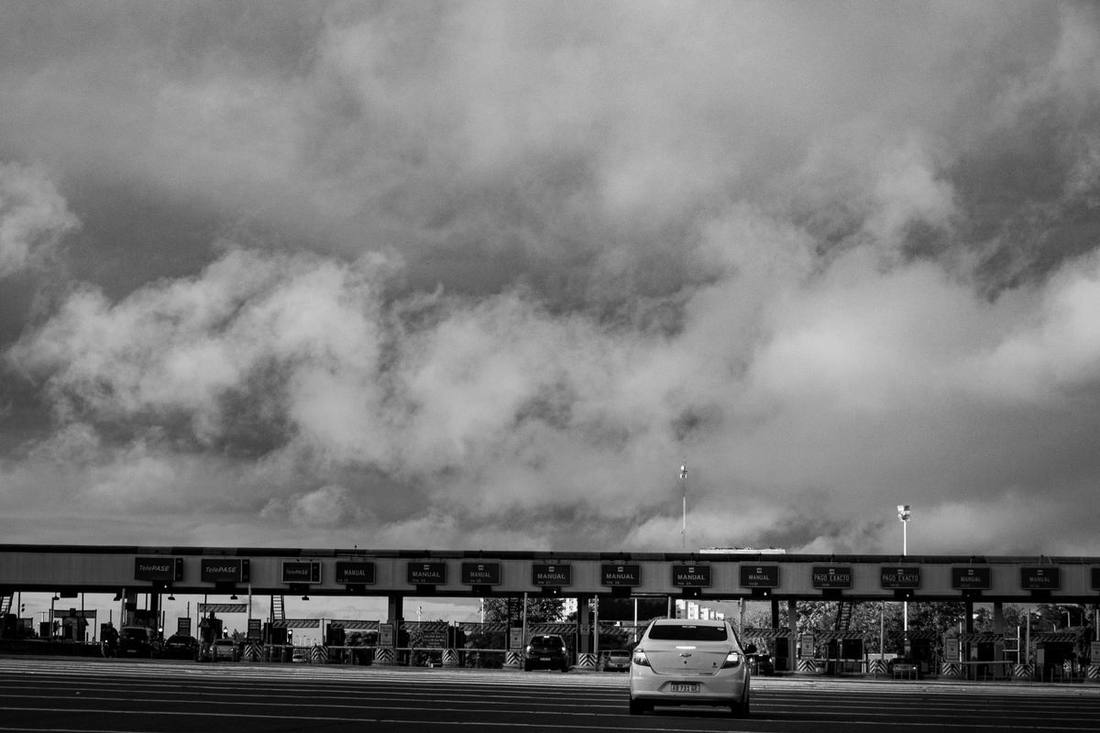
The toll is per kilometre, and the rate depends on the zone (the road is divided into zones — the light-traffic western and eastern ends are cheaper than the busy central section between the 400 and the 404), the time of day (weekday peak periods, roughly 6 to 10 a.m. and 3 to 7 p.m., carry the highest rates; midday weekdays a middle rate; evenings, weekends and overnight the lowest), and the vehicle class (light vehicles — cars, SUVs and vans under 5,000 kg — pay the base rate; heavy vehicles more). Every trip also carries a small fixed trip toll. The 407 ETR publishes its rate chart (linked below) and changes it, usually upward, most years. The provincially owned 407 East, from Brock Road in Pickering to Highway 35/115, charges its own lower rates set by the province.
Transponders, cameras and the account
A transponder — a small unit on the windshield, leased from the 407 ETR — records each trip at the gantries and bills the account monthly; a vehicle without a transponder is photographed and billed by plate at a higher rate plus a camera charge. Every vehicle in our fleet carries a transponder, so the toll we pass through is the transponder rate, at cost, with no camera charge and no markup. The receipt shows the toll as the 407 ETR's statement will show it to us.
What it costs on the common runs
The 407's rate chart gives the numbers, and the engine shows the estimate for your booking at the time you will travel; the shape is this. From the 427 (Pearson's access) to Yonge Street is about 20 kilometres across the central zone; to the 404 about 27; to Markham Road about 35; to Brock Road in Pickering about 48; to the 412 at Whitby about 55; to the 418 at Oshawa about 65. Westward, from the 427 to Trafalgar Road in Oakville's north is about 30; to the road's end at the 403 in Burlington about 45. At the peak rate the central-zone kilometres are the road's most expensive, and a Pearson-to-Markham toll at 5 p.m. is several times a Pearson-to-Markham toll at 11 p.m. The Pearson to the north-east article and the Pearson to the east article give the distances by destination.
When it saves enough time
The 401 across the top of Toronto and the QEW through Mississauga and Oakville are at their worst from 6:30 to 9:30 a.m. and 3 to 6:30 p.m. on weekdays, and in those windows the 407 saves twenty to forty minutes to Markham, Richmond Hill, Thornhill and Vaughan's north, thirty to fifty to Pickering, Ajax, Whitby and Oshawa, twenty to forty to North Oakville and Burlington, and ten to twenty to Bayview Village, Don Mills and Scarborough's north. Outside those windows the free roads flow and the 407 saves five minutes or none. On the days the 401 or QEW is closed outright — a collision, a tanker, an overnight construction closure — the 407 saves an hour or more at any hour. The rush hour article has the peaks.
When it does not
South of the 401 — downtown, midtown, the west end, the Beaches, Etobicoke — the 407 is out of the way and never helps. To Mississauga, except its far north-west, the 401, 403 and QEW are enough. To North York Centre and the neighbourhoods around Yonge and the 401, the 407 to Yonge and south through Thornhill adds distance and helps only when the 401 is stopped. Overnight and midday, almost nowhere. A chauffeur who takes the 407 at 1 p.m. on a flowing 401 has spent your money for nothing, and ours do not.
The line item: how it works at booking
When the engine sees a booking where the 407 could help — a destination north of the 401, east of the DVP or west of the 427, particularly at a peak hour — it adds a 407 ETR line to the quote with the estimated toll for the route and the time, unchecked. You check it to approve or leave it to decline. Approving it does not mean the chauffeur will use the road; it means the chauffeur may, if the live traffic makes it worthwhile, and the toll will then appear on the receipt at cost. Declining it means the chauffeur stays on the free roads whatever the traffic, and the fixed fare is all you pay. Most passengers approve it as a contingency and are charged for it on perhaps one trip in four.
The line item: how it works on the receipt
If the chauffeur used the 407, the receipt shows a line — "407 ETR toll" — with the amount the transponder recorded for the kilometres driven, at the rate for the time driven, no more. If the chauffeur did not, there is no line. A passenger who approved the toll and sees no line has a chauffeur who judged the 401 was fine; a passenger who declined it and sat in a ninety-minute 401 has a chauffeur who honoured the choice. The flat rate article and the what is included article place the toll among the fare's exclusions.
The chauffeur's rule
Approved or not, the chauffeur's decision is made from the live traffic as the car leaves — the provincial feed, the navigation's estimates, the chauffeur's own knowledge of the hour — against a simple rule: use the 407 when it saves fifteen minutes or more, or when the free road is closed; otherwise stay off it. The rule protects the passenger's money and time in the same motion, and the a day in the life article describes how many times a day it is applied.
The toll-free links: the 412 and 418
Highways 412 (from the 401 at Whitby's western edge north to the 407) and 418 (from the 401 at Oshawa's eastern edge north to the 407) were built as toll roads and made toll-free by the province in April 2022; they are now the free connectors between the 401 and the 407 in Durham, and they make Whitby's and Oshawa's 407 access the cheapest in the region after the main road's charge. The Whitby guide and the Oshawa guide cover them.
The corporate account's 407 policy
A company can set the 407 as policy on its corporate account — approved for all its addresses, approved for the peaks only, or declined — so that its bookers need not decide each time and its statement shows the tolls as a recoverable expense; the corporate travel policy article suggests approving it for any address north of the 401 and the corporate account billing article shows how the tolls appear on the statement. Most Markham, Richmond Hill, Vaughan and Durham accounts approve it as policy.
A worked example: two Markham runs, one toll
Monday, 7:30 a.m., Unionville to Terminal 1, corporate account with the 407 approved as policy: the 401 is red from the 404 to the 427; the chauffeur takes Kennedy north to the 407 and west to the 427 — 33 kilometres at the peak rate — and the run is forty-two minutes against the 401's ninety; the toll is on the statement. Wednesday, 1 p.m., the same passenger home from Terminal 1: the 401 is flowing; the chauffeur takes it; fifty minutes; no toll on the statement. Same account, same policy, one toll in two trips, both the right call.
407 quick reference
| Run (from the 427 at Pearson) | Toll distance | Peak time saved | Off-peak time saved | Chauffeur's rule |
|---|---|---|---|---|
| To Yonge (Thornhill / Richmond Hill) | ~20 km | 20–40 min | 0–5 | 407 at the peaks |
| To the 404 (Markham Centre) | ~27 km | 30–45 | 0–5 | 407 at the peaks |
| To Markham Rd (Scarborough north / Markham east) | ~35 km | 25–45 | 0–5 | 407 at the peaks |
| To Brock Rd (Pickering) | ~48 km | 30–50 | 0–10 | 407 at the peaks |
| To the 412 (Whitby) | ~55 km + 412 free | 40–50 | 0–10 | 407 at the peaks |
| To the 418 (Oshawa) | ~65 km + 418 free | 40–55 | 0–10 | 407 at the peaks |
| To Trafalgar Rd (North Oakville) | ~30 km | 20–40 | 0–5 | 407 at the peaks |
| To the 403 (Burlington / Hamilton) | ~45 km | 20–40 | 0–10 | 407 at the peaks |
| Downtown, midtown, Mississauga, Etobicoke | — | None | None | Never |
Approving it
The engine shows the 407 line item with its estimate wherever it could help; approve it as a contingency and the chauffeur uses it only when it earns its cost. The Pearson page has the airport's procedure and the fares page the principle.
The road itself: interchanges, speed and the reason it flows
The 407 runs from the QEW/403 in Burlington through Oakville's and Milton's north, across Mississauga's and Brampton's edge to the 401/410 interchange, across Vaughan (the 400, the 427), Richmond Hill and Markham (Yonge, Bayview, the 404, Woodbine, Kennedy, McCowan, Markham Road) to Pickering (Brock Road), where the provincial 407 East takes over to Highway 35/115 with the 412 and 418 links. It flows because its tolls suppress its traffic — the point of the pricing — and its 100 km/h limit and light traffic make it the safest highway in the region per kilometre driven; the passenger safety article notes it. Its one weakness is the 401/410 interchange in Brampton and the 400 interchange in Vaughan at the peaks, where the free roads' traffic joins and leaves.
Booking notes for the 407
Three small things. Approve it as a contingency on any booking north of the 401, east of the DVP or west of the 427 — it costs nothing unless used and it is the difference on a bad morning. Set it as policy on a corporate account so the bookers need not think about it. And read the receipt: a 407 line means the chauffeur judged it worth your money that day, and no line means the free road was fine.






