The bag is not there. Now what.
If your checked bag does not arrive at Pearson, go to your airline's baggage service desk inside the baggage hall (before exiting customs for international flights) and file a Property Irregularity Report — you will need the bag tag receipt, your itinerary and a delivery address. The airline traces the bag and, when found, delivers it to your address, usually within 24 to 72 hours. Your chauffeur waits: text "bag missing, filing a report," and the chauffeur holds at Door A or in the cell lot; the time counts against the fare's included wait (60 minutes after an international arrival) and beyond it at the waiting rate. Airlines are liable for delayed, damaged and lost baggage under the Montreal Convention (about CAD 2,400 per passenger) and Canada's Air Passenger Protection Regulations, and you can claim reasonable interim expenses.
Roughly one checked bag in two hundred is delayed on arrival worldwide — more on connections, fewer on non-stops — and at an airport of Pearson's size that is several hundred a day, each one a passenger at a carousel watching the belt stop. The arrival that follows is a procedure, and it goes better when the passenger knows it: the desk, the report, the delivery, the claim. It also goes better when the car outside is not a source of anxiety, which is what the chauffeur's part of this article is about. It covers what to do in the baggage hall step by step, what the chauffeur does and what it costs, the delivery and how to receive it, the airline's liability and the expenses you can claim, the connection cases where the bag is at another airport, the damaged-bag procedure, the AirTag question, and the prevention that reduces the odds.
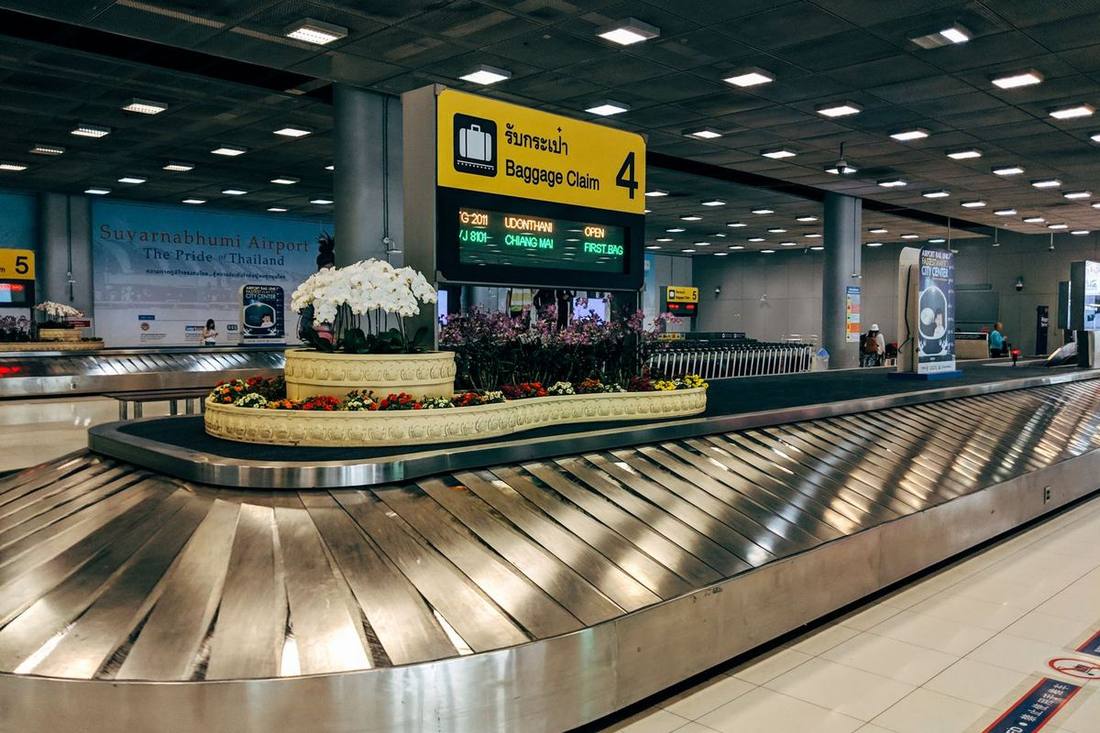
Step one: the baggage service desk
Every airline at Pearson has a baggage service desk in or beside the baggage hall — Air Canada's are in both terminals' international and domestic halls; WestJet's at Terminal 3; the foreign carriers' are staffed by their ground handlers (Swissport, Menzies) at a shared desk — and it is inside the customs zone for international arrivals, so the report must be filed before you exit to the arrivals level. Bring the bag tag receipt (the sticker on your boarding pass or the tag from check-in), your itinerary and identification; describe the bag (colour, brand, size, distinguishing marks — a photo on your phone helps); give the address where you will be for the next three days and a mobile number. The agent files the Property Irregularity Report (PIR) in the airline's tracing system (WorldTracer, used by most airlines) and gives you a reference number. Ten to twenty minutes at a quiet hour; thirty to forty at the afternoon bank when a whole flight's bags have missed a connection.
Step two: text the chauffeur
Before or during the filing, text your chauffeur: "one bag missing, filing a report at the Air Canada desk, maybe 30 minutes." The chauffeur replies, holds in the cell lot rather than cycling Door A, and is at the curb on your next text. If you have meet and greet, the chauffeur is already inside with you and knows the desk's location. Nobody at our end is counting minutes aloud; the flight delays article explains the wait policy — 60 minutes after an international arrival's actual time and 30 after a domestic one are included, and beyond that the waiting rate applies in 15-minute increments, itemised on the receipt. A forty-minute filing after a fifty-minute customs hall is thirty minutes over, two increments, and the receipt will show it and the chauffeur will not mention it.
Step three: the delivery
Most delayed bags are found within hours — they were on the next flight, or they missed the connection at Frankfurt and are on tomorrow's — and the airline delivers them to the address on the PIR, by courier, usually within 24 to 72 hours; the airline's tracing site (with the PIR reference) shows the status, and the courier calls ahead. A hotel address works (the bell desk receives it); a home address works; a cruise ship does not (see below). If you move — a hotel for two nights, then a friend's — update the address through the airline's tracing site or by phone. The chauffeur's part is done; some passengers ask us to collect a bag from the airport's baggage office when the airline offers pickup rather than delivery, and that is a fixed-fare run the engine prices.
What the airline owes you
Under the Montreal Convention (which governs international carriage) airlines are liable for delayed, damaged and lost checked baggage up to a limit of about 1,288 Special Drawing Rights — roughly CAD 2,400 per passenger — and under Canada's Air Passenger Protection Regulations the same limit applies to domestic flights and airlines must reimburse reasonable interim expenses (toiletries, essential clothing) for a delayed bag, with a bag not found in 21 days deemed lost. Keep receipts for what you buy while the bag is delayed, claim within the airline's deadlines (21 days for delayed baggage under the Convention, 7 for damaged), and escalate to the Canadian Transportation Agency if the airline does not respond. Travel insurance and some credit cards add cover above the limits; the expense reports article covers the receipts a business traveller needs, including ours for the waiting time.
The connection case: the bag is in Frankfurt
Most delayed bags at Pearson missed a connection — a tight change at Frankfurt, Heathrow, Chicago or Montreal, and the passenger made the flight and the bag did not. The PIR is still filed at Pearson with the arriving airline (the last carrier is responsible under the Convention, even if another carrier lost it), and the delivery is to your Toronto address when the bag arrives on the next flight. A passenger continuing to another city — landing at Pearson and driving to Kingston or Niagara — gives the destination address, and the airline delivers there; the Pearson to Niagara article mentions the Falls' hotels receiving delayed bags weekly.
The cruise case: the ship has sailed
A cruise passenger whose bag does not arrive on embarkation day has a harder problem: the ship sails at six and the bag arrives tomorrow. The cruise line's shore agent at the terminal handles it — the bag is delivered to the ship's next port, or held for the passenger's return — and the passenger boards with a day bag and the line's emergency kit; the cruise passengers article covers the terminal, and the advice is to fly in the day before embarkation for exactly this reason.
Damaged bags
A bag that arrives broken — a wheel gone, a shell cracked, a zipper torn — is reported at the same desk before leaving the hall, with photographs; the airline repairs, replaces or compensates within the Convention's limits, and the deadline to claim is seven days. The chauffeur will carry it to the car with the rest; a broken wheel is our problem for the twenty metres to Door A and the airline's after that.
The AirTag question
Bluetooth trackers in checked bags — Apple's AirTags and their equivalents — have made delayed bags findable by their owners, and airlines now accept a tracker's location as evidence in tracing; a passenger who sees the bag's tag still at Frankfurt while standing at Pearson's carousel can tell the desk exactly where it is, which shortens the trace. The trackers are permitted in checked baggage by Transport Canada and the airlines. Our chauffeurs have driven passengers to the airport's cargo area more than once because an AirTag showed the bag there and the airline's system did not.
Prevention: the odds and how to shorten them
Non-stop flights lose fewer bags than connections; connections longer than ninety minutes lose fewer than tight ones; bags checked at the counter lose fewer than bags checked late at the gate; a bag with the airline's tag and your name inside and outside is found faster; a photo of the bag and its contents on your phone helps the description and the claim; carry-on for the essentials — medication, a change of clothes, chargers, anything you cannot be without for two days — makes a delay an inconvenience rather than a crisis. The families with luggage article adds the family version: the children's essentials in the carry-on, always.
The chauffeur's part, summarised
The chauffeur waits, without comment, for as long as it takes; counts the time against the included wait and then at the waiting rate, itemised; takes the delivery address if you want it noted; carries whatever arrived; and, if the airline offers pickup rather than delivery, makes the fixed-fare run to the baggage office when the bag comes in. A passenger with meet and greet has the chauffeur beside them at the desk; the meet and greet article covers the add-on. The what is included article lists the wait among the fare's inclusions.
A worked example: Heathrow via Frankfurt, one bag short
Lufthansa from Frankfurt lands at Terminal 1 at 15:30 on a Friday in August; the passenger connected from a delayed Heathrow flight with forty minutes at Frankfurt. Customs takes fifty minutes at the afternoon bank; at the carousel at 16:25 one of two bags is missing. She texts the chauffeur at 16:28: "one bag missing, filing." The Lufthansa desk (staffed by Swissport) is thirty metres away; twenty-five minutes with the tag receipt, a photo of the bag and her Yorkville hotel's address; the PIR reference on her phone by 16:55, and WorldTracer already shows the bag at Frankfurt for tomorrow's flight. Through the doors at 17:00, ninety minutes after touchdown — thirty over the included hour, two increments on the receipt. Door A at 17:03, the Four Seasons at 17:50. The bag arrives at the hotel's bell desk at 19:00 the next day. Her interim expenses — a toiletry kit and a blouse — are on a receipt for Lufthansa.
Lost luggage quick reference
| Step | Where | Time | Notes |
|---|---|---|---|
| File the PIR | Airline's baggage desk in the baggage hall (before customs exit) | 10–40 min | Tag receipt, itinerary, description, address, mobile |
| Text the chauffeur | From the desk | — | Chauffeur holds in the cell lot; time counts against the included wait |
| Trace | Airline's site with the PIR reference | Hours to days | Most bags found within 24 h |
| Delivery | Courier to your address | 24–72 h | Update the address if you move |
| Interim expenses | Keep receipts; claim from the airline | Within 21 days | Reasonable essentials |
| Lost (not found in 21 days) | Claim | Up to ~CAD 2,400 per passenger | Montreal Convention / APPR limit |
| Damaged bag | Same desk, before leaving; photos | Claim within 7 days | Repair, replace or compensate |
Booking with the wait built in
Every airport pickup we make includes the wait after an international arrival that a baggage filing usually fits inside; the engine takes the flight number and the Pearson page has the procedure. Put the essentials in your carry-on.
Business travellers: the suit that is in Frankfurt
A business traveller whose bag with the suit is in Frankfurt and whose meeting is at 9 a.m. has a specific problem, and the chauffeur has driven it before: from Door A to a Bay Street tailor or a department store that opens early (the Eaton Centre's and Yorkville's do), a suit off the rack, and the meeting on time; the executive car service article covers the district and the corporate account holds the receipt for the airline's interim-expense claim. The hotels' concierges arrange the same and the chauffeur knows which ones do it well.
Booking notes when a bag is missing
Three small things. Text the chauffeur before you queue at the desk, not after; the chauffeur holds in the cell lot and nobody is cycling the curb. Give the desk the address where you will actually be for three days, not the address on your ticket. And put the medication and the chargers in the carry-on next time — every chauffeur has heard the story.






